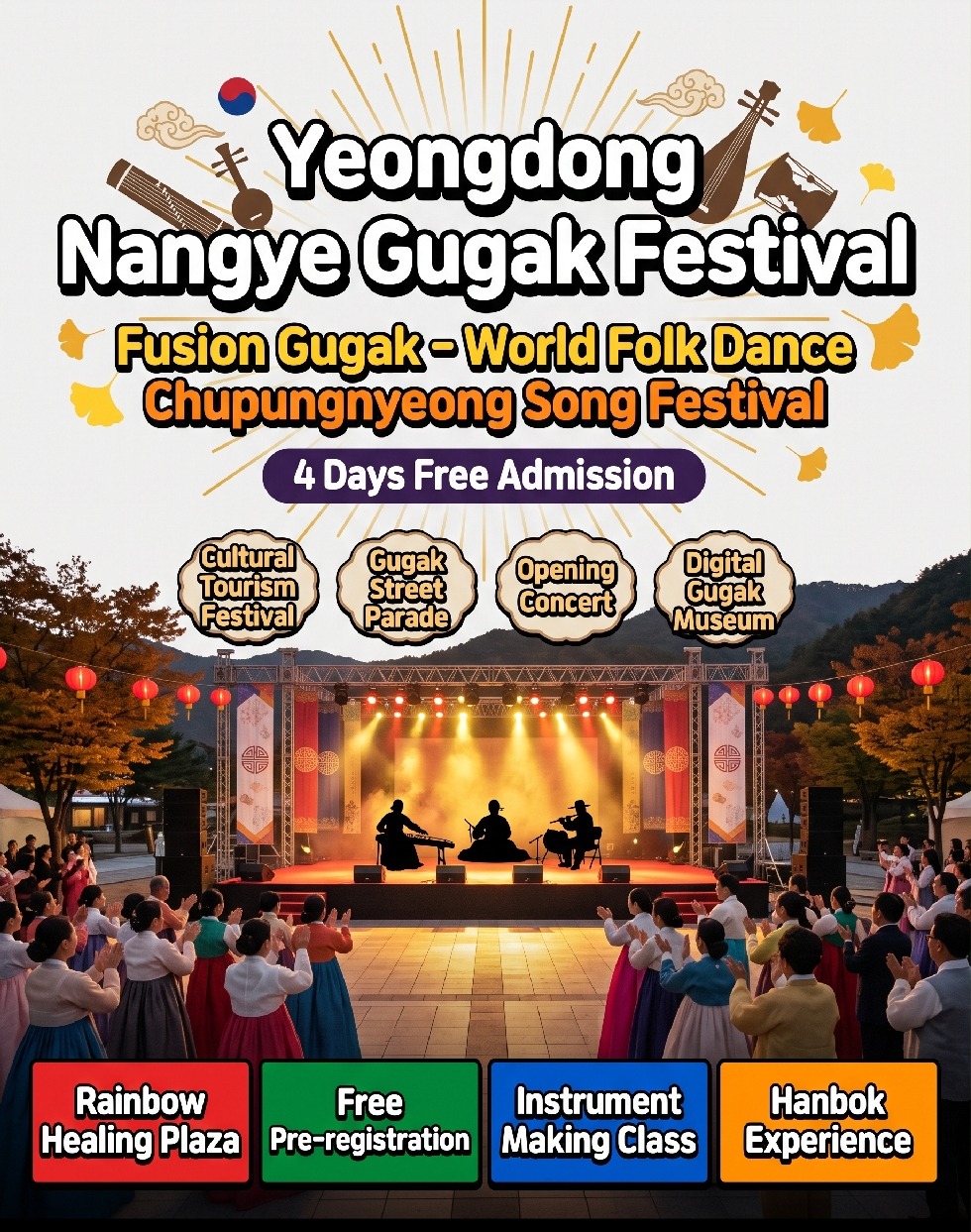
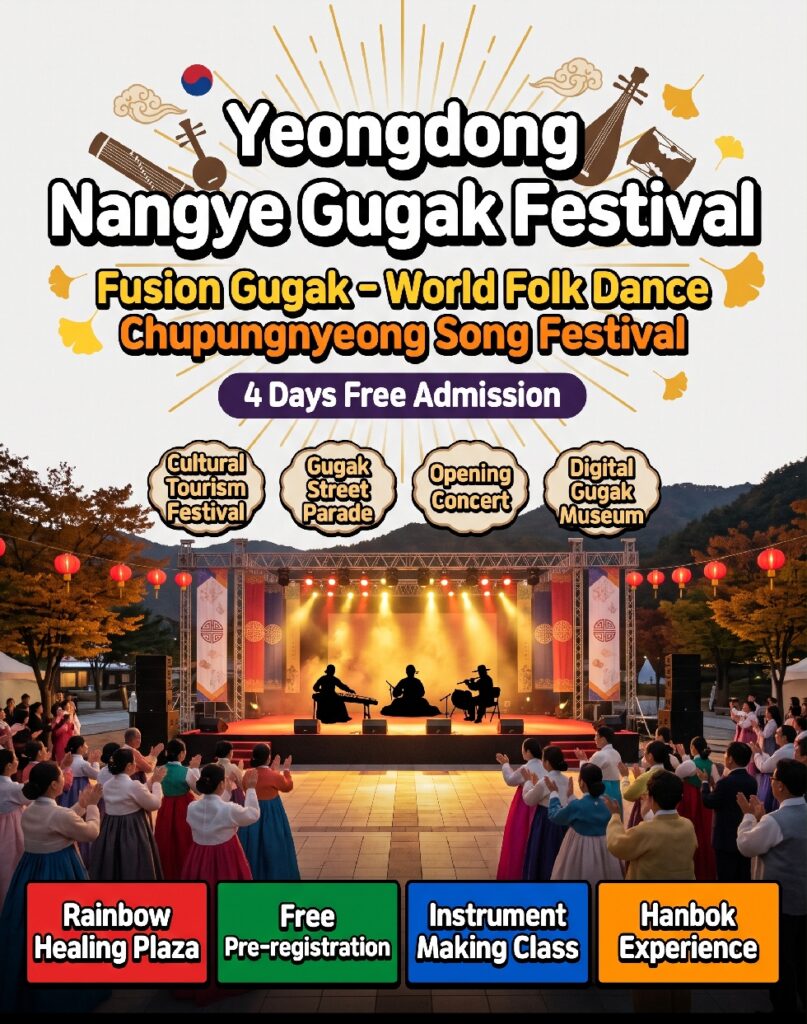
Korea’s only dedicated traditional music festival — free admission, 57 years running, and a lineup that goes from ancient court music to fusion gugak and world folk dance? 🎶 The Yeongdong Nangye Korean Traditional Music Festival runs October 15–18, 2026, at Rainbow Healing Plaza in Chungbuk. Instrument-making workshops, the Chupungnyeong Song Contest, and national percussion competitions are all on the schedule. Full guide below. 🥁
※ Check the official website for the most accurate and up-to-date information.
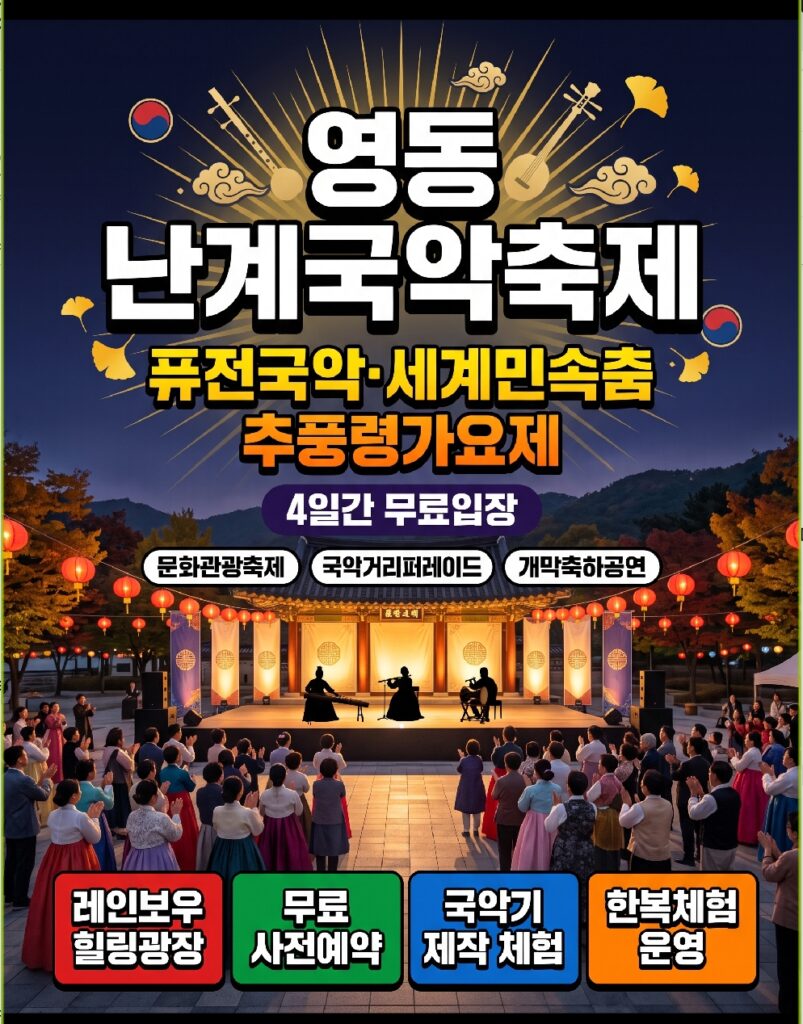
The Yeongdong Nangye Korean Traditional Music Festival (영동 난계국악축제) honors the musical legacy of Nangye Park Yeon (난계 박연, 1378–1458), a court musician of the Joseon Dynasty who standardized Korea’s classical music system under King Sejong. Now in its 57th year, this is the only festival in South Korea dedicated entirely to gugak — traditional Korean music — and it holds a designation from the Ministry of Culture, Sports and Tourism as a Cultural Tourism Festival. Based on official announcements as of October 2026.
Entry is free. Some hands-on programs carry a small separate fee. Parking near the site requires a shuttle from Yeongdong Gymnasium — road access to the plaza is restricted during the festival.
Official Festival Info (English)
📊 Yeongdong Nangye Korean Traditional Music Festival at a Glance
Korea’s only gugak specialist festival — free entry, 57th edition, Ministry-designated Cultural Tourism Festival
October 15–18, 2026 (4 days), at Rainbow Healing Plaza, 117 Yeongdong Healing-ro, Yeongdong-eup, Yeongdong-gun, Chungcheongbuk-do. Free admission; some programs carry a separate fee.
Dates: Thursday, October 15 – Sunday, October 18, 2026
Venue: Rainbow Healing Plaza, Yeongdong-gun, Chungcheongbuk-do
Admission: Free (some hands-on programs may carry a separate fee)
Parking: Use Yeongdong Gymnasium car park → festival shuttle bus to venue
Inquiries: 043-745-8917
Yeongdong Nangye Korean Traditional Music Festival Key Info
Thursday, October 15 – Sunday, October 18, 2026
The Yeongdong Nangye Korean Traditional Music Festival is South Korea’s only festival dedicated exclusively to gugak — traditional Korean music — now in its 57th year. The main program covers classic gugak, fusion gugak, world folk dance, and children’s performances across the four days. The 21st Chupungnyeong Song Contest and the National Percussion Competition also run during the festival. Instrument-making and performance workshops, Gugak Golden Bell challenges, and hanbok try-on stations are part of the hands-on offerings.
Vehicle access past Maecheon Intersection is restricted; park at Yeongdong Gymnasium and take the festival shuttle to the plaza.
1. Yeongdong Nangye Korean Traditional Music Festival: 3 Things to Know
What Is Gugak — and Why Yeongdong?
Gugak (국악) is the collective term for Korea’s traditional music — encompassing court music (jeongganbo notation system, still in use today), folk songs, pansori (a dramatic solo vocal form accompanied by a single drum), sanjo (instrumental improvisation), and pungmul (communal percussion and dance). It is distinct from K-pop and contemporary Korean music; gugak has roots reaching back more than a thousand years.
The Yeongdong Nangye Korean Traditional Music Festival is held in Yeongdong because Nangye Park Yeon (난계 박연) was born there. Park Yeon served as the chief court musician under King Sejong of the Joseon Dynasty (r. 1418–1450) and is credited with standardizing Korea’s traditional music notation and instruments. The festival was founded to preserve and promote his legacy and has grown into the country’s primary annual showcase for the full spectrum of gugak, from the most traditional to contemporary fusion interpretations. The 2026 edition is also building on the momentum of the 2025 Yeongdong World Traditional Music & Arts Expo.
Main Program: Classic, Fusion & World Folk Dance
The performance program across the four days covers four main strands: classic gugak (정통국악), featuring pansori, pungmul, and court music ensembles; fusion gugak (퓨전국악), where traditional instruments meet contemporary arrangements that even first-time listeners find accessible; world folk dance (세계민속춤), bringing international performing groups to the Rainbow Healing Plaza stage; and children’s performances (어린이 공연), which are a good starting point if you’re bringing young visitors who are new to Korean traditional arts.
The Chupungnyeong Song Contest and Percussion Competition
The 21st Chupungnyeong Song Contest (추풍령가요제) is one of Korea’s regional singing competitions with a long track record of launching new artists into the national music scene. Watching the final round is free. The National Percussion Competition (전국풍물경연대회) brings pungmul teams from across the country to compete — a high-energy ensemble performance involving drums, gongs, cymbals, and dance. Both events are among the most crowd-drawing moments of the festival.
💡 Trip.com lists train options from Seoul to Yeongdong Station on the Gyeongbu Line — travel time is approximately 2 hours. Comparing train and express bus fares before booking is worth a few minutes of research.
Yeongdong is a small city, and accommodation options are limited compared to larger regional hubs. Agoda and Booking.com both carry properties in Yeongdong as well as nearby Gimcheon (about 30 minutes south) and Okcheon (about 30 minutes north), which offer more variety. Book early for the October 15–18 window.
2. Dates, Venue & How to Get to the Yeongdong Nangye Korean Traditional Music Festival
Rainbow Healing Plaza — Venue Overview
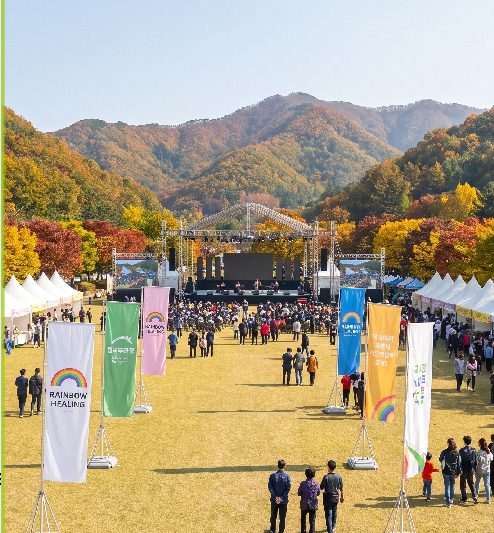
The Yeongdong Nangye Korean Traditional Music Festival takes place at Rainbow Healing Plaza (레인보우힐링광장), located at 117 Yeongdong Healing-ro, Yeongdong-eup, Yeongdong-gun, Chungcheongbuk-do. The plaza is part of the Rainbow Healing Tourist Site — a purpose-built cultural and recreation area that also hosts the Digital Gugak Museum (디지털 국악박물관), where visitors can explore the history and instruments of Korean traditional music through interactive displays. A Gugak Theme Park and festival photo zones are also on the grounds.
During the festival, road access past Maecheon Intersection (매천교차로) is restricted. Visitors arriving by car must park at Yeongdong Gymnasium (영동체육관) and board the festival shuttle bus to the plaza. Arriving before 9:00 AM is advisable to secure parking and avoid the shuttle queue.
Getting There from Seoul & Incheon Airport
From Seoul Station, trains on the Gyeongbu Line stop at Yeongdong Station (영동역) with a travel time of approximately 2 hours (check Trip.com or the Korail website for current schedules and fares). From Yeongdong Station, the festival venue is reachable by local bus or taxi.
From Incheon International Airport, take the AREX express train to Seoul Station (approx. 43 minutes), then transfer to a Gyeongbu Line train toward Busan with a stop at Yeongdong. Total journey from the airport to Yeongdong is approximately 3 hours. Express bus from Seoul’s Express Bus Terminal (고속버스터미널) to Yeongdong is also an option — travel time is approximately 3 hours 20 minutes (per available route data).
Heading to Yeongdong by train or express bus? Check the timetable in advance — note that this page is in Korean, so your browser’s translate feature will help.
3. Tickets & Booking: 4 Steps for Foreign Visitors
Step 1: Confirm Free Entry
The Yeongdong Nangye Korean Traditional Music Festival has no admission charge for any of the main performances — classic gugak, fusion gugak, world folk dance, children’s concerts, the Chupungnyeong Song Contest, and the National Percussion Competition are all free to watch. Some hands-on programs — such as traditional instrument making — may carry a small materials fee. Check the official festival website for the current list of paid versus free activities.
Step 2: Plan Your Parking
If you’re arriving by private car, road access past Maecheon Intersection is restricted. The official parking area is Yeongdong Gymnasium; from there, festival shuttle buses run to Rainbow Healing Plaza. No pre-booking is needed for parking — arrive early (before 9:00 AM recommended) to avoid queues.
Step 3: Sign Up for Hands-On Programs
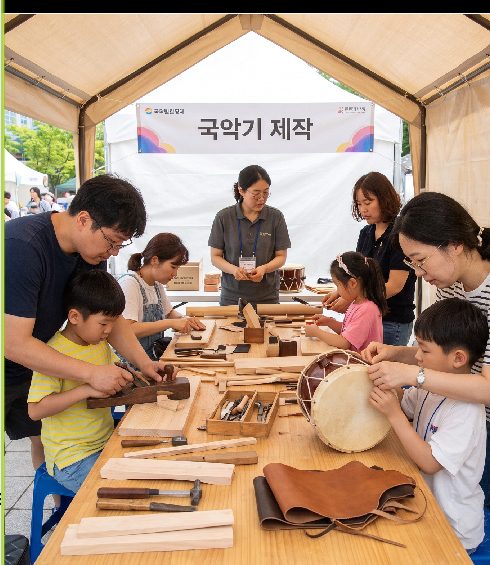
The traditional instrument making workshop (국악기 제작 체험), instrument performance session (연주 체험), and the Gugak Golden Bell quiz challenge (도전 국악골든벨) are popular and may fill on a first-come basis at the venue. Ask at the festival information desk on arrival for the day’s schedule and registration method.
Step 4: Hanbok Try-On and Photo Zones
Hanbok (한복, traditional Korean dress) try-on booths operate at the festival grounds — wearing hanbok for photos against the Rainbow Healing Plaza backdrop and festival staging makes for a distinctive combination. The Digital Gugak Museum on-site is worth visiting for context on the instruments and history you’ll hear during performances.
Official Festival Info (English)
4. Where to Eat & Stay near the Yeongdong Nangye Korean Traditional Music Festival
Local Food near Yeongdong
Yeongdong-gun is one of Korea’s primary grape-growing regions, and local restaurants in the area often feature grape-based side dishes, grape wine (포도주), and seasonal produce. The Yeongdong area is also known for dried persimmon (곶감, gotgam) — look for small shops near the town center. For meals during the festival, food stalls operate on the Rainbow Healing Plaza grounds. Prices are generally modest; budget KRW 7,000–12,000 per person for a simple meal (approx. USD $5–9).
Accommodation in and around Yeongdong
Yeongdong city has a limited number of hotels and guesthouses. Agoda and Booking.com list options in Yeongdong itself; if availability is low, nearby Gimcheon (approx. 30 minutes south) and Okcheon (approx. 30 minutes north) have more choices with good transport links back to the festival. Search Trip.com to compare prices across platforms simultaneously.
Nearby Attractions
The Yeongdong area has several attractions worth combining with a festival visit: the Nangye Park Yeon Memorial Hall (난계사), Yeongdong Wine Tunnel (영동 와인터널, a former railway tunnel now used to age local wine), and the surrounding mountain trails. If you have an extra day, the Chupungnyeong Valley (추풍령) area offers autumn foliage that typically peaks in mid-October — the same week as the festival.
5. Yeongdong Nangye Korean Traditional Music Festival vs. Other Korean Music Festivals at a Glance
| Category | Yeongdong Nangye Korean Traditional Music Festival | Typical Regional Festival |
|---|---|---|
| Theme | Gugak only (traditional to fusion) | Mixed or popular music |
| Admission | Free (main stages) | Free to paid |
| Duration | 4 days | 2–3 days average |
| Government Recognition | Ministry of Culture — designated Cultural Tourism Festival | Varies |
| Competition Programs | Song contest + national percussion competition | Rare |
| Workshops | Instrument making, performance, Golden Bell | Limited |
| International Program | World folk dance | Uncommon |
6. 5 Tips for Foreign Visitors to the Yeongdong Nangye Korean Traditional Music Festival
Arrive Before 9:00 AM If Driving
Vehicle access to Rainbow Healing Plaza is restricted past Maecheon Intersection during the festival. Parking at Yeongdong Gymnasium fills early, particularly on weekends (October 17–18). Arriving before 9:00 AM gives you the best chance of parking without a long wait for the shuttle. If you’re coming by train or bus, the Yeongdong bus and taxi network connects the station to the venue — confirm the current local taxi fare at the station information desk.
Fusion Gugak Is the Best Entry Point for First-Timers
If you’re new to Korean traditional music, the fusion gugak (퓨전국악) stage is the recommended starting point. These performances blend haegeum (a two-stringed fiddle), geomungo (a plucked zither), and daegeum (a large bamboo flute) with contemporary rhythms and arrangements — making the music more immediately accessible than classical court music formats for listeners unfamiliar with the genre.
Try the Instrument Workshop Early
The traditional instrument-making workshop is one of the most popular hands-on programs at the Yeongdong Nangye Korean Traditional Music Festival. Spots are limited and allocated on a first-come basis at the program desk. Head to the information tent as soon as you arrive and ask about that day’s session schedule. A completed instrument — even a simple one — is a distinctive souvenir.
Wear Hanbok for the Photo Zones
Hanbok try-on stations are available at the festival grounds. Combining traditional dress with the Rainbow Healing Plaza backdrop, the Gugak Theme Park, and the outdoor performance stages produces a very different kind of festival photo from what most international visitors will have at other Korean events. No reservation needed — show up at the hanbok booth.
Payment and Language at the Venue
Yeongdong is a small city, and English signage at the festival venue is limited compared to larger urban festivals. The official English information page on VisitKorea provides a useful pre-visit summary. At the venue, using a translation app (Google Translate, Papago) on your phone covers most interactions. Cash is useful for small purchases and food stalls — Korean Won only. Major credit cards are accepted at most structured program counters. A helpful Korean phrase: “이거 얼마예요?” (I-geo eol-ma-ye-yo? — “How much is this?”)
💡 Trip.com offers train tickets from Seoul to Yeongdong — booking in advance secures better seat selection on the Gyeongbu Line, particularly for weekend travel.
The Yeongdong Nangye Korean Traditional Music Festival gives international visitors access to a living tradition that is almost impossible to encounter in this concentrated form anywhere else. Fifty-seven years of programming, free admission, and a venue that combines performance with museum and workshop space — it’s a genuinely undervisited festival for anyone interested in Korean cultural heritage.
Frequently Asked Questions
A. It is the only annual festival in South Korea with an exclusive focus on gugak — traditional Korean music — covering the full range from classic court and folk music to fusion interpretations. It holds a Ministry of Culture, Sports and Tourism designation as a Cultural Tourism Festival and has run continuously for 57 years.
A. The traditional instrument-making workshop is available at the festival grounds. Spots are allocated on a first-come basis — go to the festival information desk as soon as you arrive to check the day’s schedule and available sessions. Some hands-on programs may carry a small materials fee.
A. Yes. The Chupungnyeong Song Contest and the National Percussion Competition are free to watch. All main stage performances — including classic gugak, fusion gugak, and world folk dance — are free to attend.
A. The 57th Yeongdong Nangye Korean Traditional Music Festival runs Thursday, October 15 through Sunday, October 18, 2026, at Rainbow Healing Plaza, 117 Yeongdong Healing-ro, Yeongdong-eup, Yeongdong-gun, Chungcheongbuk-do, South Korea. Admission is free.
More to Explore
If you enjoy free nature festivals in Korea happening the same weekend, also check out the Gwangju Seochang Silver Grass Festival — a 4 km riverside walk with sunset views, a trolley bus, and pet-friendly programs along the Yeongsan River.
Heading to Yeongdong by train or express bus from Seoul? Check timetables and book in advance — weekend seats fill quickly during October festival season.
Heading to Yeongdong by train? Check the timetable in advance — note that this page is in Korean, so your browser’s translate feature will help.
For international visitors who want to experience something genuinely distinct from mainstream Korean pop culture, the Yeongdong Nangye Korean Traditional Music Festival is worth the journey. The fusion gugak stage is accessible even for listeners with no prior exposure to traditional Korean music — and the instrument-making workshop is the kind of hands-on cultural experience that you simply cannot replicate in a city museum. Go early, park at Yeongdong Gymnasium, and head straight to the information desk.
Sources: Yeongdong-gun official website (yd21.go.kr/en); Korea Tourism Organization, english.visitkorea.or.kr (as of October 2026).
We cover festivals, events, travel, parks, and cultural experiences across Korea — compiled from official sources.
We verify information against the latest official announcements before publishing.
https://en-event.jhs29.com